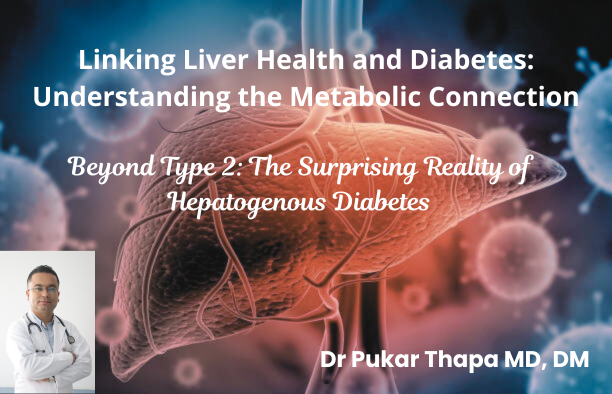
Linking Liver Health and Diabetes: Understanding the Metabolic Connection
Beyond Type 2: The Surprising Reality of Hepatogenous Diabetes
For decades, the medical community has viewed the relationship between the liver and blood sugar through a single lens: diabetes as the culprit behind liver destruction. We are well-versed in how chronic high sugar levels fuel fatty liver disease, eventually scarring the organ into cirrhosis. However, there is a "mirror image" to this metabolic story that is finally coming to light—an "upstream" effect where the failing liver itself triggers a unique, aggressive form of diabetes.
This condition is known as Hepatogenous Diabetes (HD). First identified in 1906 by the scientist Naunyn, HD is a distinct metabolic disorder caused by the physiological fallout of liver cirrhosis. Despite its century-long history and its presence in a staggering number of patients, it remains a "neglected" and "underappreciated" complication, often overshadowed by the very condition it mimics.
The Silent Imposter: Why Standard Tests Fail
One of the most dangerous aspects of Hepatogenous Diabetes is its ability to hide behind "normal" test results. In a standard screening, clinicians typically rely on Fasting Blood Glucose (FBG) or the HbA1c test. However, in patients with cirrhosis, these metrics are often chronic liars.
Standard tests fail because cirrhosis frequently alters the lifespan of red blood cells through anemia or splenomegaly (an enlarged spleen). Since HbA1c measures the sugar "coated" on red blood cells over time, a shorter cell life leads to deceptively low readings. To catch this imposter, the medical community must pivot to the Oral Glucose Tolerance Test (OGTT). Because HD often presents as subclinical glucose intolerance, the OGTT is the only reliable tool capable of revealing the metabolic struggle occurring beneath the surface.
"Depending on the etiology, the degree of liver damage and the diagnostic criteria, the incidence of glucose intolerance varies from 60-80% [in cirrhotic patients]."
This diagnostic gap means that for many, the "diabetes of the liver" is a ticking clock that remains unread until the damage is advanced.
The Liver is the Master Thermostat
While we traditionally credit the pancreas as the sole regulator of blood sugar, the liver actually serves as the body’s master metabolic thermostat. It maintains glucose homeostasis through four critical, finely-tuned pathways:
- Glycolysis: The breakdown of glucose to produce energy.
- Gluconeogenesis: The creation of new glucose from non-carbohydrate sources.
- Glycogenolysis: The breakdown of stored glycogen back into glucose for a quick energy boost.
- Glycogenesis: The process of converting excess sugar into glycogen for storage.
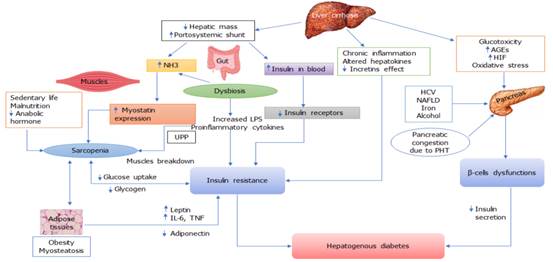
When cirrhosis ravages the liver, this thermostat is essentially shattered. The failure of these pathways triggers systemic insulin resistance that ripples outward, affecting not just the liver, but also muscle and fat tissues. When the liver can no longer store or create energy effectively, the entire "house" of the body loses its ability to regulate its internal metabolic temperature. Once this thermostat breaks, the body’s structural "insulation"—the skeletal muscle—begins to waste away.
A Marker of "System Overload"
The numbers tell a story of total metabolic collapse: as the liver’s structural integrity fails, so does the body’s ability to handle sugar. Hepatogenous Diabetes is not just a side effect; it is a high-definition red flag signaling the severity of end-stage liver disease.
The prevalence of HD scales almost perfectly with the deterioration of liver function as measured by the Child-Pugh classification:
- Child-Pugh Class A: 20.5% prevalence
- Child-Pugh Class C: 61% prevalence
For clinicians, the emergence of HD signals that the liver’s dysfunction has effectively broken the body’s metabolic tools. It is a sign of "system overload," indicating that the liver can no longer compensate for the toxins and hormonal imbalances flooding the bloodstream.
The Sarcopenia Connection: The Muscle-Sugar Link
A healthy body relies on skeletal muscle as its primary "sugar sink," responsible for approximately 85% of all glucose disposal. In patients with liver disease, however, this sink is often dismantled by sarcopenia (muscle loss).
The link is driven by hyperammonemia—elevated ammonia levels that the failing liver can no longer detoxify. This "toxic leak" from the gut puts the muscle-sugar-sink under siege, triggering a cascade of failure across the gut-liver-axis:
- Gut Dysbiosis: Altered bacteria damage the gut barrier, allowing toxins to migrate.
- Endotoxemia: Translocated gut-derived toxins (LPS) enter the bloodstream, fueling systemic inflammation and insulin resistance.
- Myostatin Expression: High ammonia levels trigger myostatin, a protein that actively blocks muscle growth and accelerates wasting.
As muscle mass disappears, the body loses its ability to clear sugar from the blood, creating a vicious cycle of rising glucose and falling physical strength.
The Treatment Minefield
Managing Hepatogenous Diabetes is a "therapeutic dilemma" that is significantly more precarious than treating standard Type 2 Diabetes. The very tools used to save a diabetic patient can become lethal in the presence of cirrhosis.
- Hepatotoxicity: Most common oral hypoglycemic drugs require hepatic metabolism; in a damaged liver, these drugs can accumulate and become toxic.
- The Hypoglycemia Trap: Because cirrhotic livers cannot store glycogen or perform gluconeogenesis properly, these patients have no "safety net" if their blood sugar drops. They are at a much higher risk for severe, life-threatening hypoglycemia.
- The Insulin Paradox: Insulin is often a "dangerous necessity." While it is frequently the only option left for advanced cases, its use in cirrhotic patients has been linked to an increased risk of Hepatocellular Carcinoma (HCC), or liver cancer.
The Ultimate Reset Button?
Unlike standard Type 2 Diabetes, which is often a lifelong progressive journey, HD offers a rare possibility: it can be cured. Because HD is a direct complication of the liver’s failure, a successful liver transplant (LT) can act as a metabolic reset button.
Research shows that diabetes regresses in approximately 63.9% of patients following a transplant. By replacing the failing organ, the body’s metabolic homeostasis is restored. However, this reset isn't universal. If chronic high sugar levels have been allowed to persist long enough to cause permanent "glucotoxic" damage to the pancreatic beta-cells, the diabetes may remain even after the liver is replaced.
Conclusion: A Call for Recognition
Despite over a century of evidence, Hepatogenous Diabetes still faces a wall of professional skepticism. Major organizations related to Liver and Diabetes have yet to recognize it as a distinct entity, largely due to a "classification dilemma"—the fact that both cirrhosis and diabetes have long, silent courses that make it difficult to prove which came first.
This lack of recognition is not just a matter of semantics; it is a clinical hazard that leaves doctors without standardized guidelines for a highly vulnerable population. As we move toward a more integrated future of hepatology and endocrinology, we must acknowledge that the liver is a central pillar of metabolic health. If we have known about "the diabetes of the liver" since 1906, why are we still treating it as a secondary thought rather than a primary complication?
Keywords:
liver and diabetes, hepatogenous diabetes, diabetes and liver disease, liver cirrhosis, fatty liver diabetes, metabolic liver disease, diabetes complications, Dr. Pukar Thapa, hepatologist nepal, liver health nepal